What Does the Prostate Do? A Complete Guide for Men Over 50
Most men reach their 50s without ever receiving a clear explanation of what the prostate does — or why its location makes it so influential on daily life.
Most men go through decades of life without ever thinking about their prostate. Then something shifts, usually somewhere in their 50s, and suddenly this small gland becomes the center of attention. The urgency at night. The slow start in the morning. The feeling that the body is no longer cooperating the way it used to.
Before a man can make sense of what’s happening, he needs to understand what was already there. What the prostate actually is, what it actually does, and why its position in the body makes it so influential over things that have nothing to do with reproduction. That’s what this guide covers, plainly and completely.
Where the Prostate Is Located
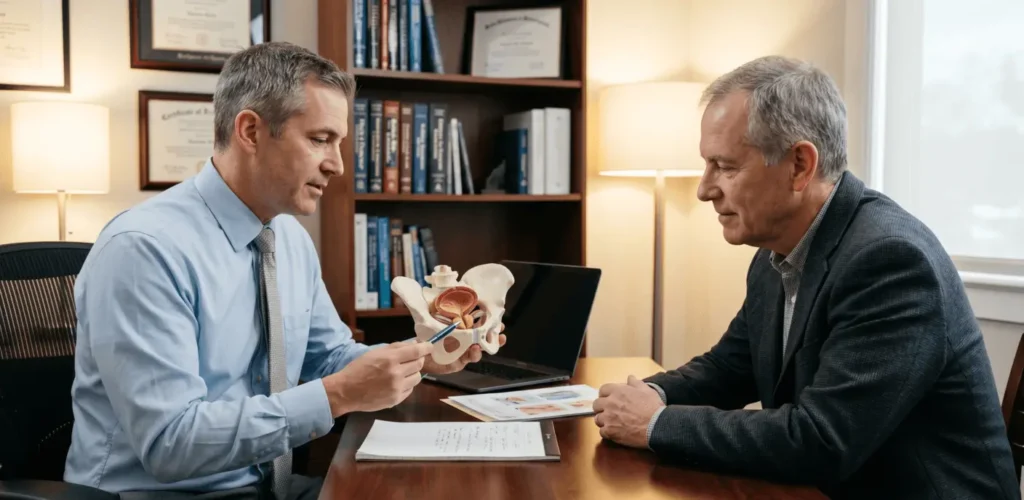
The prostate is a small glandular organ found only in men, positioned directly below the bladder and in front of the rectum. It surrounds the urethra, the tube that carries urine from the bladder out through the penis during urination and semen during ejaculation.
Its location is the most important thing to understand about the prostate, because that location is the reason why changes in its size have such a direct and immediate effect on urinary function. The urethra doesn’t pass near the prostate. It passes through it. Any increase in prostate size, however gradual, applies pressure to the urinary channel from all sides simultaneously.
In a healthy adult man, the prostate is roughly the size and shape of a walnut, weighing approximately 20 grams. This measurement is not fixed throughout life. The prostate grows in two distinct phases, with the second phase beginning in the 30s and continuing indefinitely, which is why urinary symptoms related to prostate size become increasingly common as men move through their 50s and 60s.
The Primary Function: Reproductive Fluid Production
The prostate’s core biological function is to produce a component of seminal fluid. During ejaculation, the prostate contracts and releases this fluid into the urethra, where it mixes with sperm from the testicles and fluid from the seminal vesicles to form semen.
The fluid produced by the prostate serves several specific purposes in the context of reproduction. It contains enzymes, zinc, and citric acid that help protect sperm and support their ability to function after ejaculation. One of the prostate’s key secretions is prostate-specific antigen, commonly known as PSA, a protein that helps keep semen in a liquid state and allows sperm to move freely.
PSA is produced exclusively by prostate tissue. While its biological role is reproductive, it has become clinically significant as a marker measured in blood tests to help monitor prostate health. Elevated PSA levels can indicate prostate enlargement, inflammation, or, in some cases, the presence of prostate cancer, which is why PSA testing has become a standard part of prostate health screening discussions for men over 50.
The Secondary Function: Urinary Control
While reproduction is the prostate’s primary job, its position gives it a secondary influence over urinary function that becomes increasingly relevant as men age.
The smooth muscle tissue within the prostate plays a role in controlling the flow of urine through the urethra. During ejaculation, the prostate and surrounding muscles contract to prevent urine from mixing with semen and to direct seminal fluid in the correct direction. Between these events, the prostate’s tone and size influence how freely urine can pass through the urethral channel.
This dual role in both reproductive and urinary function is what makes the prostate such a clinically significant organ in men’s health, even though its size is modest and its location is internal and largely invisible to the man himself.
How the Prostate Changes Over a Man's Life
Understanding prostate function requires understanding that the gland is not static. It changes meaningfully at several points across a man’s lifespan.
During childhood, the prostate is small and relatively inactive, weighing only a few grams and producing minimal secretions.
At puberty, in response to rising testosterone, the prostate undergoes its first significant growth phase, expanding to its adult walnut size of approximately 20 grams. This growth stabilizes in the early 20s and is entirely normal.
From the mid-30s onward, a second, slower phase of growth begins. Unlike the first phase, this one does not stop. The prostate continues to add tissue gradually throughout the rest of a man’s life. For many men, this gradual growth remains clinically insignificant for decades. For others, the expanding gland eventually reaches a size or configuration that begins to affect urinary flow, typically producing noticeable symptoms in the 50s and 60s.
By age 60, the average prostate weighs between 30 and 40 grams. By age 80, it may weigh significantly more. The degree to which this growth affects day-to-day life varies considerably between individuals and is influenced by both the direction of growth and the resilience of the surrounding structures.
What the Prostate Does Not Do
Because prostate health is discussed primarily in the context of problems, several misconceptions about prostate function have become common.
The prostate does not produce testosterone. Testosterone is produced primarily in the testicles. The prostate is a target tissue for certain hormones rather than a source of them.
The prostate does not store urine. The bladder stores urine. The prostate’s relationship to urinary function is mechanical rather than storage-related. It influences how urine exits the body, not how much the body holds.
The prostate does not cause erections. Erections are primarily a vascular and neurological event, controlled by blood flow and nerve signals. The prostate does not initiate or sustain this process, though the nerves responsible for erections run in close proximity to the prostate, which is why certain prostate procedures carry a risk of affecting erectile function.
Having an enlarged prostate does not mean a man has prostate cancer. Benign Prostatic Hyperplasia, the non-cancerous enlargement of the prostate, and prostate cancer are entirely separate conditions. The presence of one does not cause or indicate the other.
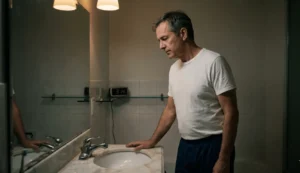
The bathroom is often where men first notice that something has changed. Understanding the prostate’s role in urinary function is the first step toward making sense of those changes.
The PSA Connection: What the Prostate Tells Doctors
Prostate-Specific Antigen deserves its own explanation because it is both a natural byproduct of normal prostate function and one of the most discussed numbers in men’s health.
PSA is a protein produced exclusively by prostate cells. Small amounts of it naturally enter the bloodstream, which is why a blood test can measure it. In a healthy prostate, PSA levels are typically low. When the prostate is enlarged, inflamed, or affected by cancer, PSA production often increases, raising blood levels.
A PSA test alone cannot diagnose any condition. It is a signal, not a verdict. Elevated PSA can reflect benign prostate enlargement, a temporary prostate inflammation, a urinary tract infection, or, in some cases, prostate cancer. Interpreting a PSA result requires context: a man’s age, the size of his prostate, his baseline PSA from previous tests, and the rate of change over time.
The reason PSA matters to a discussion of prostate function is that it demonstrates something important. The prostate is not a passive organ. It is biochemically active in ways that produce measurable effects in the bloodstream. Monitoring those effects over time gives physicians a window into prostate health that would otherwise require invasive examination.
Why Location Makes the Prostate Uniquely Influential
No other gland in the male body occupies a position quite like the prostate’s. Its location at the intersection of the urinary and reproductive systems means that changes in its size or health have the potential to affect two major aspects of daily life simultaneously.
This is why prostate health is not a niche concern for older men. It is a central component of male physiology that becomes increasingly relevant across the second half of a man’s life. The symptoms associated with prostate enlargement, from disrupted sleep to changes in urinary flow to shifts in sexual function, are not separate problems with separate causes. They are connected expressions of what happens when a single small organ, positioned at a critical anatomical crossroads, changes over time.
Understanding this connection is not a medical luxury. It is the foundation for recognizing symptoms early, making informed decisions about evaluation, and approaching the second half of life with the kind of clarity that comes from actually knowing how your body works.
Key Takeaways
The Clearer Picture Starts With Your Own Numbers
Understanding what the prostate does is one thing. Understanding what your prostate is doing right now is another.
Thomas Reed’s free 2-minute Prostate Health Assessment gives men over 50 a personalized look at their current symptom pattern. It takes less than 45 seconds and gives you a starting point for the conversation worth having, whether with a physician or with yourself.
Send this report to a friend via: